
Why not to “put all your eggs in one basket”? (Finance Edition)
- Shreyanshi Nayak

- Apr 26
- 4 min read
Updated: Apr 27
Firstly, let’s start with a picture that makes sense in real life.
Imagine you are on the way back from the supermarket, carrying ONE basket that contains a dozen eggs. Suddenly that basket slips from your hand, and ALL the eggs crash. Unfortunately, now you have no eggs left. Now imagine if you split those 12 eggs into 3 baskets. If one falls, you still have 8 eggs left.
Hence, in financial terms, “putting all your eggs in a single basket” refers to concentrating all your money on a single investment or asset. This phrase highlights one of the key financial principles- Risk management through diversification. While it sounds simple, this principle plays a significant role in how individuals and institutions protect and grow their wealth.

Although putting all your money into one popular stock or growth sector might seem like a good idea, it is also exposing you to considerable risk. When a person’s portfolio only consists of one stock, they are making themselves entirely susceptible to the performance of that one stock. If something happens to the company, like poor performance, changes in regulation or even unexpected events around the globe (Covid-19), the financial consequences can be very serious. According to a well-accepted theory in finance, the value of an individual stock could drop significantly over a short time while the value of a diversified portfolio is much less likely to encounter that amount of uncertainty.
So basically, putting all your eggs in one basket could work if you got lucky, but if it doesn't then you don't have a safety net to fall back on. This is why many investors don’t put all their money into one stock, no matter how appealing it appears. Many financial communities also point out how unpredictable the market is and, how even “strong” stocks can go down due to various reasons that the investor cannot control. Many users point out that overconfidence in a single stock usually results in losses that could have been prevented. Therefore, spreading all your eggs into multiple baskets is an essential way of successfully investing.
Furthermore, diversification helps to diminish the effects of unsystematic risks, which is unique to an individual or industry. It is near impossible to eliminate all the risks of investing in the market but, by investing in several companies, you are reducing the chance of one company's failure resulting in the entire portfolio losing its value.

In finance, the concept behind not putting all your eggs in one basket is known as diversification. This is essentially about spreading your investments across different assets to reduce risk. Instead of placing all your money into one company, or one type of investment, diversification encourages investors to allocate their funds across a variety of assets such as stocks, and mutual funds. The reason this works, is because different investments do not react the same way to market conditions. For example, when stock markets fall, gold may remain stable or even increase in value, while others like property, may decrease. As highlighted previously, having investments in different “baskets” means that while some may decline, others may not be affected, which helps minimise overall risk.
Think of it as, not all industries perform well at the same time. Tech stocks might boom one year, while healthcare stocks perform better in another. So, if your money is spread across different sectors, you are less dependent on one single outcome. Diversification is rooted in the idea that investors should avoid relying on just “one company, one sector, or one region,” since any of these could underperform depending on changing economic conditions.
In simple terms, diversification does not guarantee profits, but it balances the ups and downs. You might not always get the highest possible return, but you significantly reduce the chance of major losses. That’s why it is considered one of the most fundamental and widely accepted principles in investing.
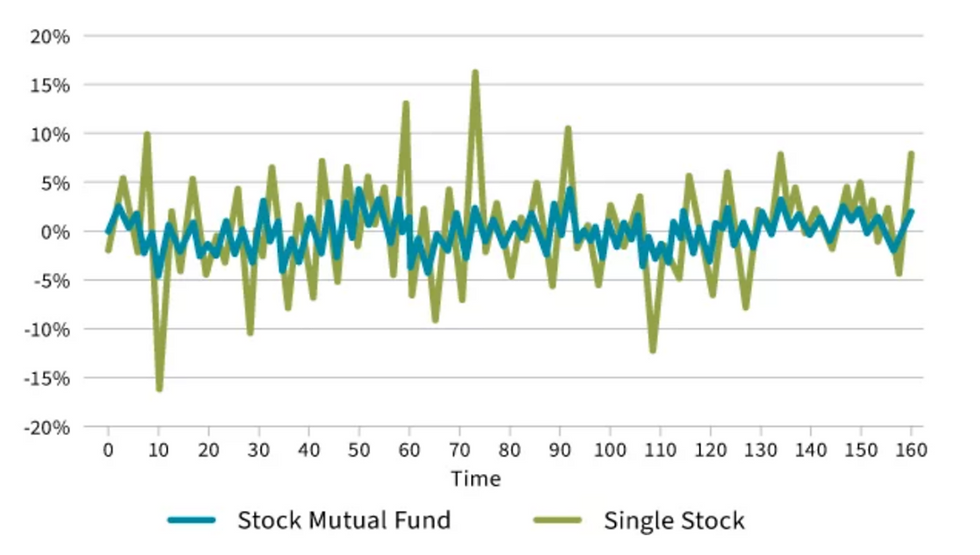
This diagram highlights how quickly prices in a single stock change, compared to the prices in a stock mutual fund. Price of a stock mutual fund fluctuates significantly less than the price of a single stock. This is because the stock mutual fund contains a mix of stocks, so if some do badly, others will offset those losses.
A strong real-world example is the Cisco Systems during the dot-com boom. Cisco Systems was considered as a “cannot fail company”, but now this example elucidates why we should not put all our eggs in one basket. In the late 1990s, Cisco was viewed as a company that was “safe” to invest in because it provided internet infrastructure for the world. It was the leading internet company, as the demand for internet technology skyrocketed. Yet, on March 10th, 2000, when the dot-com boom ended, and the bubble burst, the realities of inflated valuations and market conditions were very quick to change. At the end of 2000s Cisco stock faced an approximate 80% loss of value.

Mr Rajesh and Ms Ankita who were colleagues at the same office had completely different reactions to this crash. Mr Rajesh chose to invest all his money in a single stock, Cisco Systems, while Ms Ankita decided to divide her investment between Cisco and Microsoft.
Mr Rajesh’s choice shows a lack of diversification, as he depended entirely on one company’s performance. When Cisco’s stock crashed after the dot-com bubble, his portfolio suffered major losses and took a long time to recover.
In contrast, Ms Ankita’s decision to invest in both Cisco and Microsoft reduced her risk. Even though Cisco declined, Microsoft continued to grow, which helped balance her overall portfolio. This example shows that spreading investments can protect against losses and lead to more stable financial outcomes.


IN CONCLUSION:
Investing everything in one place might look practical at first, but spreading things out gives you a much safer shot at long-term growth.


I am so impressed by how you explained diversification using real-life examples. . It made a big, grown-up finance idea feel very easy to understand. Keep it up .
Very nice but my investment strategy is all in one basket now will definately change my strategy
Good job! Very insightful and meaningful explanations!