
Why can’t governments just print more money to solve all economic problems?
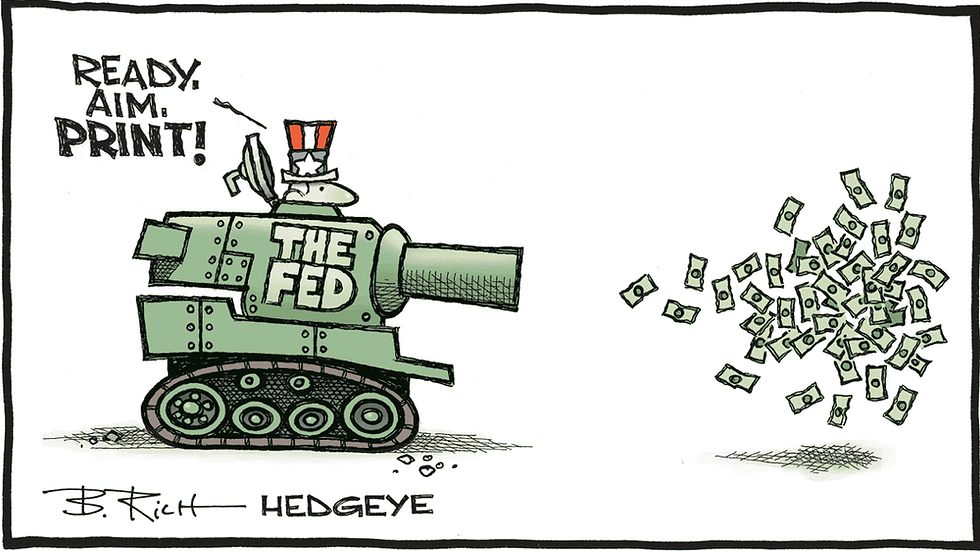
Have you ever wondered why we can’t just head to the printing presses and print out bills and bills? It sounds like a quick, efficient fix to any country’s problems – be it clearing national debt, ending poverty, funding public infrastructure, or maintaining a stagnant economy. The reality, however, is a little more complicated.
To answer a question like this, we must first ask – what is it that money does?
Money gives people purchasing power – acting as a store of value, which means it can be saved, received, or exchanged in the future without significant depreciation. Like any other good, if the supply of it increases, the value will decrease. So if there’s more money in the economy, the value – or in this case, the purchasing power – of a currency decreases.
However, money does not have an intrinsic value, that is to say, it is only as good as what it can buy in the real world. Let’s break this down with an example. Imagine today you have $5, and with it, you can buy 2 chocolate bars. Now imagine if the government gives everyone in your city $100 dollars each. The shopkeeper would realize that they could charge higher and higher prices for the chocolate bar, and your $5 wouldn’t be enough to buy even one anymore. This would cause inflation, and in some cases, hyperinflation, which happens in this case because there’s more money circulating the economy.
Examples of this have been prevalent throughout history, such as Germany, Venezuela and Zimbabwe. The governments of these 3 countries all spent far more than it earned from tax revenue, and instead of cutting spending or borrowing at sustainable rates, the central banks printed more money to pay government bills. This is called monetizing the deficit. Because the central banks print money so excessively, it triggers a vicious cycle where prices rise such that governments need even more money to pay employees and maintain services, meaning they must print money even faster.
This undermines the Central Bank’s ability to function. When it is forced to print money just to cover the government’s debt, the assets it holds make it worthless compared to the amount of paper it has issued.
In Zimbabwe in 2008, prices were increasing so rapidly that the currency became essentially worthless paper, especially as they printed more and more of higher denominations of money (Not So Fun Fact: At the height of their hyperinflation in 2009, the Reserve Bank of Zimbabwe issued a $100 trillion banknote, which was barely enough to pay for a bus fare). This caused that the savings of the middle class to be destroyed and caused the nation to plunge into deeper poverty.

The surplus of currency also causes issues on the country’s trade with the rest of the globe. Printing all this extra money causes the country’s currency to depreciate against other countries. This makes imports for the country way more expensive, and countries that rely on imported goods, which in turn will cause local prices to drive up higher.
On the contrary, the best way to cause stable growth in an economy is productivity or producing more goods and services. When the supply of goods increases alongside a controlled money supply, prices remain stable, and the standard of living improves.
In short, money is a mirror reflecting the health of an economy; adding more zeros to a bank note does not add more wealth to a nation. Actual growth comes from a country’s goods and services, not the volume of paper in circulation. Ultimately, economic stability requires a balance between what we produce and the money we spend.


Comments