
What is Black-Scholes Equation ?
Look at the price of your favourite stock – it may increase, drop, crash, or rally. What if you can exercise the right – not an obligation – to purchase your favourite stock at a given price in the near future? If the actual price is higher, you instantly make a profit. If the actual price is lower, you walk away; losing nothing but a minimal fee – known as the option premium - you paid for that right.
Every day, billions of dollars change hands for these rights. The question then becomes: what is the optimal price to pay for that right? Too much, the buyer pays more than what is required. Too less, the seller can go into deep losses.
In 1973, three economists – Fischer Black, Myron Scholes, and Robert Merton – answered it with an equation that went to win the 1997 Nobel Prize in economics. This mathematical method does not predict where the stock price will go. Instead, the formula figures out the option’s price by building a copy of it using stock prices and interest rates — whose values are already known!
Key Concepts to Understand:
Before diving into the formula, we need to understand the forces at work. An option is both an insurance against loss-making stock price movements and a lottery ticket to unlimited gains. Because it offers a big gain for a limited loss, it has value. Five primary factors are taken into account:
The stock price: The current market price of the underlying stock right now.
The strike price: The fixed price locked into the option contract.
The time remaining: The time left until the option expires
Volatility: The unpredictability of a stock. Specifically, how much the stock price typically “jumps” around.
Interest rates: The cost of borrowing money.
An equation that considers all of these factors could give a fair, scientific price instead of a guess.
The formula Revealed
In continuous time, continuous re-balancing (dynamic hedging) leads to the Black-Scholes European call formula:
C=SN(D1)-KE-rtN(D2)
Where:
d1=ln(SK)+(r+22)tt | d2=d1-σt |
Where:
C=call price | t=time to maturity (in years) |
S=Current stock price | σ=Volatility of the Underlying asset |
K= Strike Price | N= Cumulative distribution of the standard normal distribution |
r= Risk-free interest (compounded) |
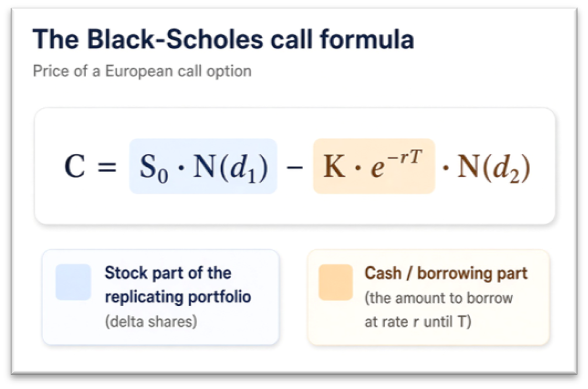
Simply put: Option Price = (Stock Component) - (Borrowed Cash Component).
Underlying assumptions:
Assumption 1: Stock Prices Change Smoothly and Predictably.
The Black-Scholes model assumes that stock prices follow the smooth, predictable pattern of a bell curve. Extreme market moves are treated as extraordinarily rare events. In reality, markets exhibit "fat tails", or extreme stock price movements, more often than the formula predicts.
Such a situation occurred on January 27, 2021. GameStop stock was trading at around $65. Then, on January 28, it jumped to $147 in a single trading session—that's a 126% increase in one day. The stock didn't gradually climb $1 per hour. It spiked suddenly because retail investors on social media coordinated a massive buying campaign.
A trader who used Black-Scholes the night before would not have been able to imagine such a situation. The equation assumes such massive one-day jumps have almost zero probability, but they do happen in real markets. The equation's pricing would be completely inaccurate.
Assumption 2: There are no transaction costs or taxes.
The Black-Scholes model also assumes frictionless, instantaneous trading without transaction costs. Suppose the equation says an option is worth exactly $50. You plan to buy it for $49, then immediately sell it for $50, making $1 profit.
In reality:
Broker charges a $5 fee to buy
Broker charges a $5 fee to sell
Government takes capital gains tax (about 20% of your profit)
The $1 profit becomes: $1 - $5 - $5 - (20% of $1) = -$9.20 loss.
Assumption 3: The volatility stays constant.
The Black-Scholes model assumes that the volatility of the stock will remain constant. In practice, volatility fluctuates continuously, leading market participants to quote options in terms of implied volatility.
Such a situation occurred on the 20th of August 2020. Tesla stock was relatively stable, with small daily price movements averaging around $2-3 per day. Black-Scholes used this historical volatility to price 3-month options at $50 per contract.
Then, on August 31, Tesla announced a 5-for-1 stock split. This made shares cheaper and more accessible to retail investors (a $2,000 share became $400). Suddenly, retail investors flooded the market to buy Tesla. This massive buying surge caused the stock to become much more unpredictable—daily movements jumped to $8-10.
Options priced on August 20 assumed small daily movements. But by September, with volatility doubled, those same options were now worth $80-90 (not $50). Traders who bought options at $50 made huge profits because volatility didn't stay constant as Black-Scholes predicted. Conversely, the bank that sold those options at $50 took massive losses.
To conclude, Black-Scholes was revolutionary. Before 1973, option pricing was guesswork. The equation became a starting point (though not gospel) by providing the first mathematically rigorous answer. Smart traders use it as a foundation, then adjust it for transaction costs, changing interest rates, and changing volatility. Understanding Black-Scholes means understanding the equation along with its limitations—separating wise traders from overconfident ones.
Works Cited
Black, Fischer, and Myron Scholes. "The Pricing of Options and Corporate Liabilities." Journal of Political Economy, vol. 81, no. 3, 1973, pp. 637–654.
"Black-Scholes Model." Investopedia, www.investopedia.com/terms/b/blackscholes.asp.
Box, George E. P. "Science and Statistics." Journal of the American Statistical Association, vol. 71, no. 356, 1976, pp. 791–799.
Cox, John C., et al. "Option Pricing: A Simplified Approach." Journal of Financial Economics, vol. 7, no. 3, 1979, pp. 229–263.
Hull, John C. Options, Futures, and Other Derivatives. 10th ed., Pearson, 2018.
Merton, Robert C. "Theory of Rational Option Pricing." The Bell Journal of Economics and Management Science, vol. 4, no. 1, 1973, pp. 141–183.


Comments